
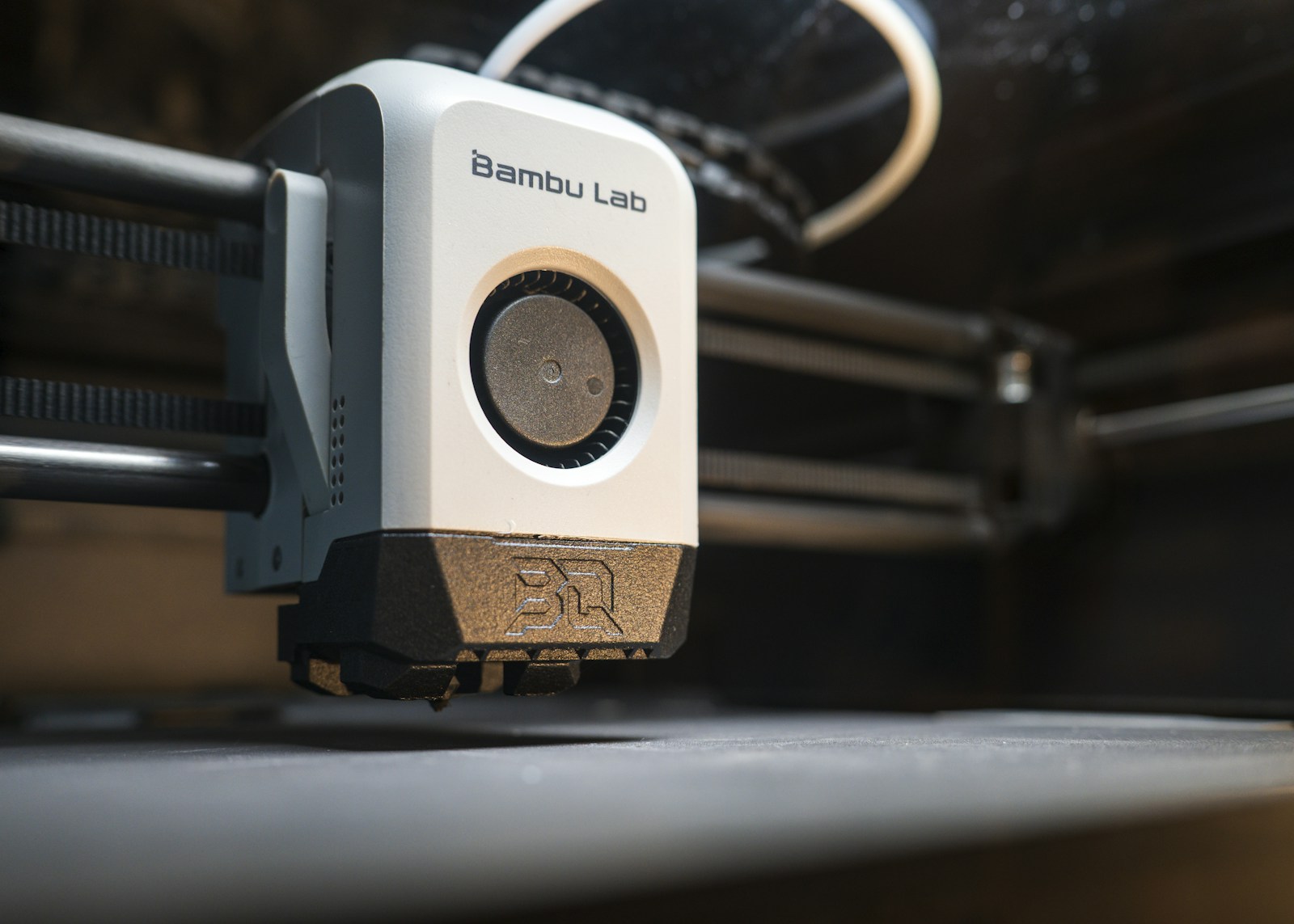
The Bambu Lab A1 is a common choice for a first 3D printer, mainly because it calibrates itself and runs quietly. It is not the right printer for everyone, though. Here is what it does well, where it falls short and what to buy instead.
About this guide: it is based on the manufacturers’ published specifications and public information, checked in October 2026. We will add our own test results when we have them. “Check price” links go to the manufacturer’s official store. If a link is an affiliate link, we may earn a commission at no extra cost to you.
The short answer
- Buy it if you want a printer that works out of the box, mostly print PLA and PETG, and might want multicolor later.
- Skip it if you need ABS, ASA, nylon or carbon-fiber parts, want open-source hardware, or have little room for a moving bed.
Specifications
| Bambu Lab A1 | |
|---|---|
| Build volume | 256 × 256 × 256 mm |
| Design | Open bed-slinger (the bed moves front to back) |
| Max speed / acceleration | 500 mm/s, 10,000 mm/s² |
| Max nozzle temperature | 300 °C |
| Max bed temperature | 100 °C |
| Nozzle | 0.4 mm stainless steel, quick-swap (0.2, 0.6 and 0.8 mm optional) |
| Best materials | PLA, PETG, TPU, PVA |
| Not recommended | ABS, ASA, PC, PA and fiber-filled filaments |
| Screen and connection | 3.5-inch touchscreen, Wi-Fi, microSD |
| Footprint | 465 × 410 × 430 mm, 8.3 kg |
Why beginners like it
It calibrates itself before every print
The A1 levels the bed, measures the nozzle height, tunes out vibrations and calibrates the flow of plastic on its own. There is no paper-under-the-nozzle routine, which is where many first-time owners get stuck.
Swapping nozzles takes seconds
The hotend is held by a single clip. If a nozzle clogs or you want a finer 0.2 mm nozzle for small details, you can change it without tools.
Multicolor is an add-on, not a new printer
The optional AMS lite feeds up to four spools. You can buy the A1 alone and add the AMS lite later, or get both as the A1 Combo.
It is quiet
Bambu Lab rates the A1 at under 48 dB in silent mode. That is quiet enough for a home office, although silent mode prints more slowly.
Where it falls short
- No enclosure. Heat-sensitive materials like ABS and ASA warp and crack without a closed chamber, and Bambu Lab does not recommend them on the A1.
- It needs room. Because the bed slides back and forth, leave free space in front of and behind the printer as well.
- A closed ecosystem. The firmware is not open source and some features work best with Bambu Studio and Bambu Lab’s cloud. A LAN mode lets you print without the cloud.
- Recall history. In 2024 Bambu Lab recalled the A1 over a heated-bed cable that could wear out. Affected printers got a free replacement part. If you buy a used A1, ask whether the fix was done. The A1 mini was not affected.
A1 or A1 mini?
The A1 mini shares most of the A1’s features in a smaller, cheaper body with a 180 × 180 × 180 mm build volume. Pick the mini if you mainly print small objects and have little space. Pick the A1 if you want room for helmets, organizers or bigger parts.
Alternatives worth a look
- Prusa MK4S: open-source, repairable and built in the EU. Costs more, but you can buy it as a kit. Read our comparison.
- Creality Ender-3 V3 SE: cheaper and simple, but expect more tuning.
- Bambu Lab P2S: the enclosed sibling, if you want ABS and ASA. See our best enclosed printers.
Verdict
For most people buying their first printer, the A1 removes the setup frustration that puts beginners off 3D printing. If you know you need engineering materials or open hardware, look at an enclosed printer or the Prusa MK4S instead.